API
Partner API Overview
Sandbox Testing
Manage Incoming Orders
Manage your Catalog of products
Manage your Promotions
Manage your Outlets
SFTP
Manage your Catalog of products
Manage your Promotions
Troubleshooting#
Click below to jump to the topics:
There’s an Error or a Problem: How Can I Debug My Integration?
How can you debug the integration from the Sandbox environment and identify the scope of the error?
How do I know my integration is live & running?#
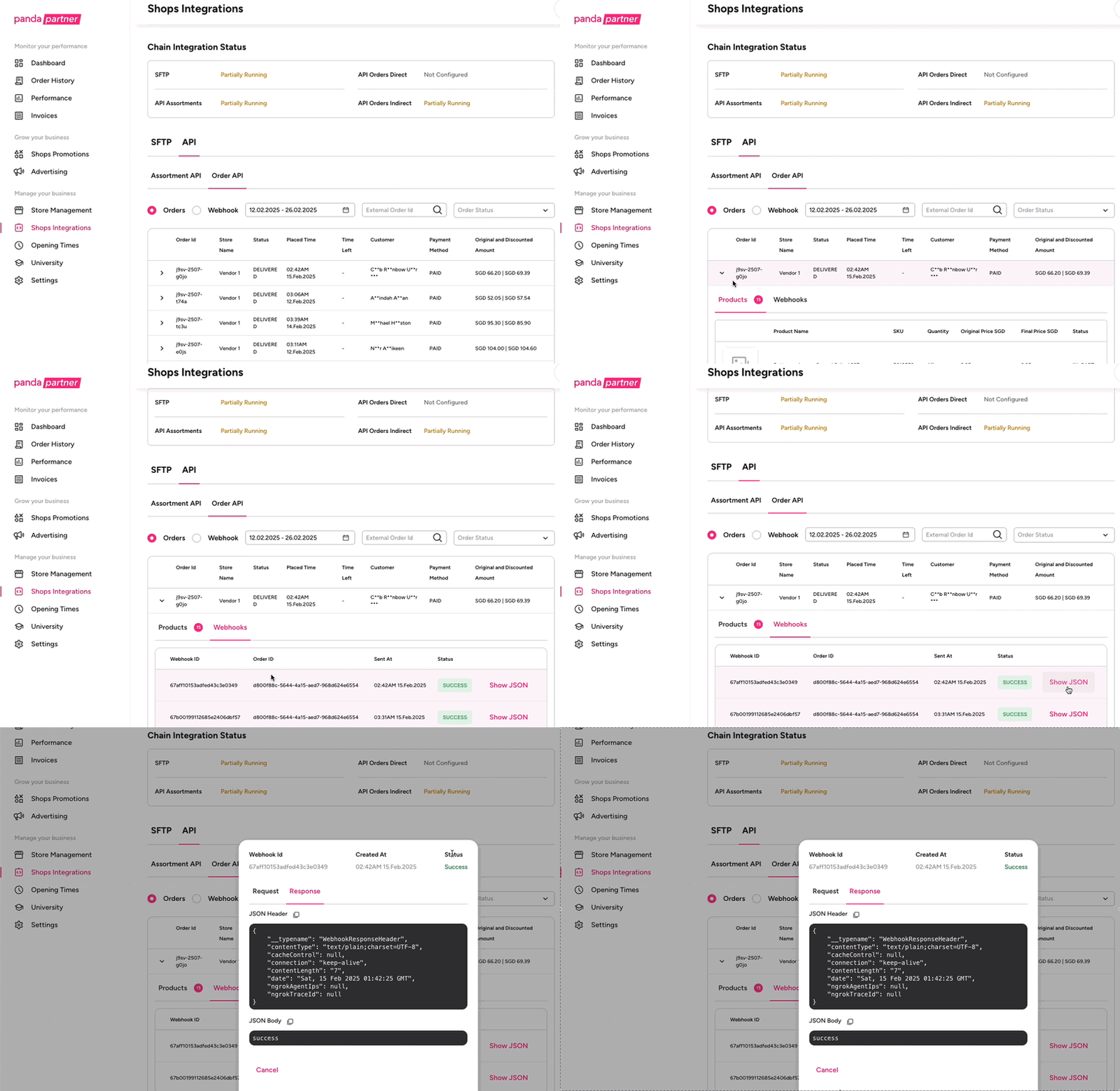
You can monitor the integrations from Partner Portal directly. When OT API triggers orders to your webhook, success or failure is logged in the Shop Integrations > Order status updates tab. In the event of an observed error, it should be resolved by the Partner.
There’s an Error or a Problem: How Can I Debug My Integration?#
If you’re experiencing issues with your integration, follow these steps to identify and resolve the problem:
Check the Shops Integrations Plugin in the Partner Portal to verify that your integration is correctly set up and there are no errors demonstrated visibly
Gather key details about the issue, including error messages, timestamps, and any relevant API request/response logs.
Assess the impact – is the issue affecting all orders/promotions/catalog updates or just specific ones? How critical is the problem for your operations?
Contact your account manager and provide:
A clear description of the issue.
Error details (logs, screenshots, API responses).
The scale and impact on your business.
Retry or test the integration to see if the issue persists after making adjustments.
Providing complete and accurate information will help speed up the troubleshooting process.
How can you debug the integration from the Sandbox environment and identify the scope of the error?#
Place an order from the test store or use the sandbox environment in Partner Portal
Partner API/Orders should trigger the order to your configured webhook
The order can be tracked from the Partner Portal -> Shop Integrations plugin
A successful POST request to your webhook will have a 200 response
If the response is 4xx or 5xx– scope of error is with Partners, logged errors in the Order status updates tab must be reviewed and appropriate actions should be taken by Partner to adjust the webhook service. Partner’s internal service logs can also be utilised for effective debugging.
How do I verify the HMAC signature of a webhook request?#
This applies if your webhook uses HMAC signature authentication (see How to configure webhook and secret). For every request:
Require exactly one
X-DH-Signatureheader whose value is exactly 64 lowercase hexadecimal characters. Reject missing, duplicate or malformed signature headers.Capture the exact, uncompressed request body bytes before JSON parsing or any other transformation. If HTTP
Content-Encodingis used, decompress the body before verification.Use the UTF-8 bytes of your signing secret as the HMAC key. Compute the HMAC-SHA256 digest over the body bytes and write it as lowercase hexadecimal.
Compare the expected and received signatures with a constant-time comparison. Reject the request if they do not match.
Process deliveries idempotently, using the event or order identifier when available. The signature covers the body only. It has no signed timestamp or replay window, and it does not prevent duplicate delivery.
Parsing and re-serializing the body before verifying changes whitespace, key order or escaping, which produces a different signature.
Python example
import hashlibimport hmacdef is_valid(secret: str, raw_body: bytes, header_value: str) -> bool:expected = hmac.new(secret.encode("utf-8"), raw_body, hashlib.sha256).hexdigest()return hmac.compare_digest(expected, header_value)
Test vector
Use this to check your implementation. It is for tests only, so never use this secret in a real environment.
| Input | Value |
| Test-only signing secret | MDEyMzQ1Njc4OWFiY2RlZjAxMjM0NTY3ODlhYmNkZWY |
| Exact request body (UTF-8) | {"order_id":"123","status":"READY"} |
| HMAC-SHA256, lowercase hex | 304ffd0a5dc5027c601585f417ce8722c5b6d0bc4ecd071e5cc6191128fb76d3 |
| Complete header | X-DH-Signature: 304ffd0a5dc5027c601585f417ce8722c5b6d0bc4ecd071e5cc6191128fb76d3 |
Common signature problems
| Symptom | Likely cause |
| Signature never matches | The body was parsed or re-serialized before hashing, or the wrong secret is in use |
| Matches in tests, fails in production | A proxy or framework changes the body, or a trailing newline is added or removed |
| Matches only for some requests | A compressed body was verified before decompression |
| Everything fails after a rotation | The verifier still uses the old secret |
| Lost the secret | It cannot be retrieved. Rotate it in Webhook Settings to get a new one |